

Nov . 03, 2025 18:25 Back to list
High-Precision Cast Iron Surface Plate | Best Price
The Pivotal Role of Precision Surface Plate in Modern Metrology
In the realm of precision manufacturing, engineering, and quality control, a surface plate serves as the fundamental benchmark for accurate measurement, inspection, and layout tasks. These meticulously crafted flat surfaces are indispensable tools, providing a stable, highly accurate datum plane against which other components can be measured or assembled. Their critical role underpins the integrity of countless industrial processes, from the automotive sector to aerospace, ensuring dimensional conformity and functional excellence.
The demand for ever-increasing precision across industries necessitates the continuous evolution of surface plate technology. Manufacturers and engineers rely on these foundational tools to verify flatness, perpendicularity, parallelism, and other critical geometric tolerances, making them central to quality assurance protocols. This comprehensive guide explores the multifaceted world of surface plates, delving into their construction, applications, technical specifications, and market dynamics.
Industry Trends and Market Evolution for Precision Surfaces
The global market for precision measurement equipment, including surface plates, is experiencing robust growth driven by advancements in automation, rising demand for quality control in manufacturing, and the increasing complexity of engineered components. Key trends shaping this market include:
- Shift Towards Higher Grades: While Grade 1 and 2 surface plates remain standard for many industrial applications, there's a growing demand for Grade 0 and 00 for ultra-precision metrology labs and sensitive research environments.
- Integration with Digital Metrology: Modern surface plates are increasingly used in conjunction with advanced digital measurement systems, such as coordinate measuring machines (CMMs) and optical measurement devices, enhancing data capture and analysis capabilities.
- Customization and Specialization: As manufacturing processes become more specialized, the need for customized surface plate designs – in terms of size, mounting options, and material composition – is expanding.
- Emphasis on Longevity and Durability: End-users are prioritizing surface plates that offer extended service life and maintain their precision under challenging industrial conditions, favoring materials like high-grade cast iron surface plates.
- Sustainability in Manufacturing: There's an emerging focus on sustainable manufacturing processes for surface plates, including energy-efficient casting and machining, and the use of recyclable materials.
The market is highly competitive, with manufacturers striving to differentiate through superior material science, advanced manufacturing techniques, and comprehensive after-sales support. The focus is on delivering not just a product, but a complete solution that integrates seamlessly into modern quality control ecosystems.
Detailed Manufacturing Process of a Precision Surface Plate
The creation of a high-precision surface plate, particularly an iron surface plate or cast surface plate, is an intricate process demanding rigorous control at every stage. The primary goal is to achieve exceptional flatness, rigidity, and dimensional stability. Here's a typical manufacturing process flow:
1. Material Selection and Preparation
The foundation of a durable and accurate surface plate begins with the material. For cast iron surface plates, high-grade fine-grained grey cast iron (e.g., HT200 or Meehanite equivalent) is preferred due to its excellent vibration dampening properties, superior wear resistance, and ability to be machined to a fine finish. This material's inherent stability and minimal thermal expansion are crucial for maintaining precision over time.
2. Casting Process
Casting: The selected cast iron is melted and poured into specially designed sand molds. The mold design incorporates a ribbed structure on the underside of the plate to provide maximum rigidity and minimize deflection under load. Proper pouring temperature and cooling rates are critical to achieve a uniform microstructure, free from internal stresses and defects. Stress Relieving: After casting and initial cooling, the raw casting undergoes an extensive stress-relieving process. This typically involves heat treatment (annealing) at controlled temperatures (e.g., 550-600°C) for several hours, followed by very slow cooling. This process alleviates internal stresses induced during casting, preventing future distortion and ensuring the long-term dimensional stability of the surface plate. Multiple stress-relieving cycles might be employed for the highest precision grades.
3. Machining and Grinding
Rough Machining: The cast blank is first machined to remove excess material and achieve approximate dimensions. This initial machining helps to further relieve residual stresses. Precision Grinding: The primary working surface is then precision ground using large-scale surface grinders. This step brings the plate close to its final flatness tolerance. Cooling lubricants are used to prevent thermal distortion during grinding.
4. Hand Scraping (Lapping)
This is arguably the most critical and skill-intensive stage for achieving high-grade flatness. Skilled technicians manually scrape the surface plate using master reference plates (typically Grade 00 or 0). A thin layer of marking compound (e.g., Prussian blue) is applied to the master, which is then rubbed against the surface plate being worked on. High spots on the plate transfer the marking compound. The technician then meticulously scrapes away these high spots. This iterative process of marking and scraping continues until the desired number of contact points per square inch is achieved and the flatness tolerance meets the specified standard (e.g., ISO 8512, DIN 876, ASME B89.3.7). This method ensures exceptional flatness and a highly uniform bearing surface.
5. Final Inspection and Certification
Once the hand scraping is complete, the surface plate undergoes a thorough final inspection in a climate-controlled metrology lab. Advanced optical interferometers, auto-collimators, and electronic levels are used to verify flatness, parallelism, and overall dimensional accuracy against established international standards like ISO, ANSI, or DIN. Each plate is typically accompanied by a calibration certificate, detailing its deviation from perfect flatness.
6. Finishing and Packaging
The finished surface plate is coated with a rust-preventative oil or lacquer, and its edges are often chamfered to prevent chipping. It is then carefully packaged, often in wooden crates, to protect its precision surface during transit. The service life of a well-maintained cast iron surface plate can extend for decades, particularly when recalibrated periodically.
Target Industries and Advantages:
These precision surface plates are critical in virtually all industries requiring high dimensional accuracy:
- Automotive: Inspection of engine components, body panels, and tooling.
- Aerospace: Critical for verifying precision components for aircraft and spacecraft, where tolerances are exceptionally tight.
- Machinery Manufacturing: Calibration of machine tools, inspection of precision parts.
- Defense: Quality control for weaponry and military equipment.
- Medical Device: Ensuring the accuracy of instruments and implants.
- Research & Development: A stable base for experimental setups and metrology.
Advantages in typical scenarios include enhanced accuracy in inspection, leading to reduced material waste and rework (energy saving), and the inherent corrosion resistance of cast iron (especially with proper maintenance) which ensures longevity even in industrial environments.
Technical Specifications and Parameters of Cast Iron Surface Plates
Understanding the technical specifications of a surface plate is paramount for selecting the right tool for a specific application. Key parameters include:
Material Composition:
Typically high-grade gray cast iron (e.g., GG20, HT200, or Meehanite equivalent), with a minimum hardness of 170-240 HB. The high carbon content (3-3.5%) ensures excellent machinability, wear resistance, and inherent damping properties.
Flatness Tolerances (Grades):
Flatness is defined by international standards. The most common grades are:
- Grade 00: Laboratory Grade (0.00005" + 0.000005" per foot, or ISO 8512-1: 1.5 + L/1000 µm) - Highest precision, for master tools, calibration, and R&D.
- Grade 0: Inspection Grade (0.0001" + 0.00001" per foot, or ISO 8512-1: 3.0 + L/750 µm) - For high-accuracy inspection, quality control.
- Grade 1: Tool Room Grade (0.0002" + 0.00002" per foot, or ISO 8512-1: 6.0 + L/500 µm) - For general inspection, tool layout, and production work.
- Grade 2: Workshop Grade (0.0004" + 0.00004" per foot, or ISO 8512-1: 12.0 + L/250 µm) - For less critical inspection and general workshop use.
Note: 'L' refers to the diagonal length of the surface plate in millimeters.
Dimensional Stability:
Achieved through extensive stress relieving (annealing and natural aging). This minimizes creep and ensures the plate retains its flatness over its service life, critical for long-term precision.
Rigidity and Ribbing:
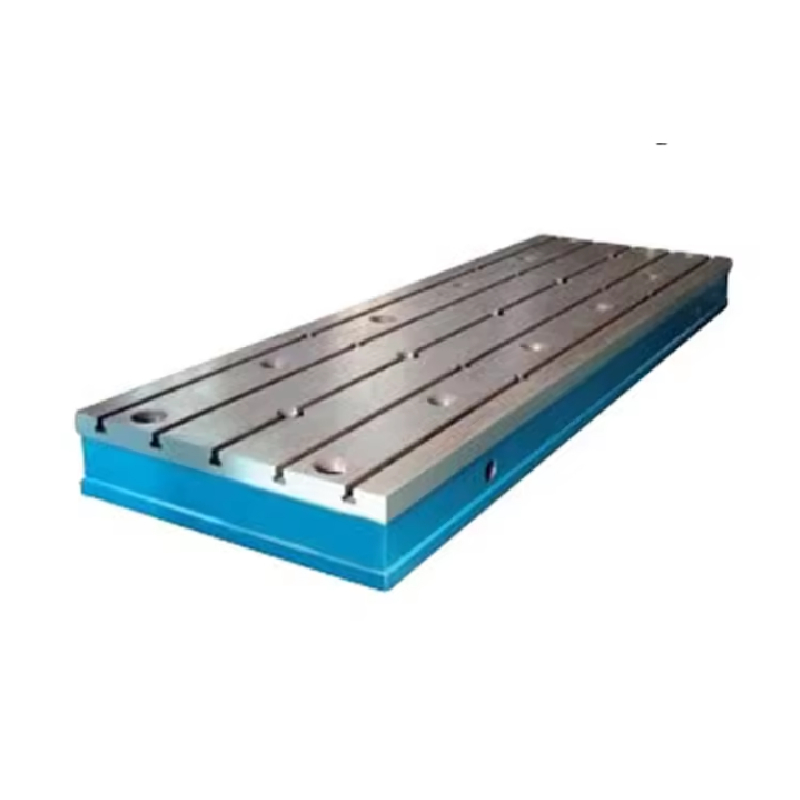
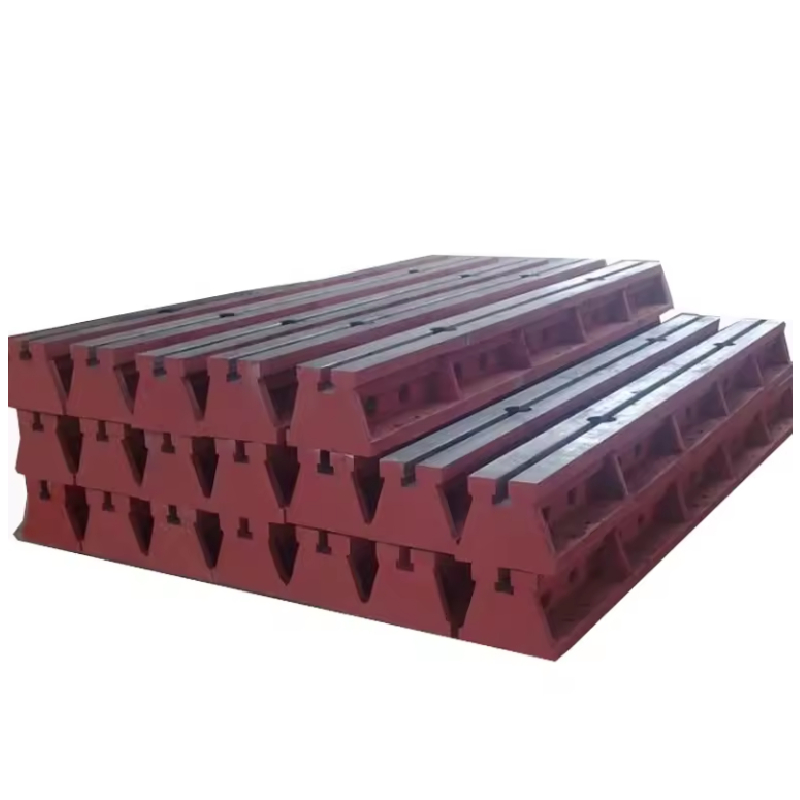
The underside of cast iron surface plates features a robust ribbed structure designed to prevent deflection under load and to maintain the specified flatness tolerance even when heavy components are placed upon it.
Thermal Expansion Coefficient:
Approximately 11-12 x 10-6 / °C for cast iron, requiring stable temperature environments for the highest accuracy measurements.
Typical Product Specification Table:
| Parameter | Description | Value / Standard |
|---|---|---|
| Material | High-grade Gray Cast Iron (HT200-HT250) | Conforming to GB/T 9439 |
| Hardness | Brinell Hardness (HB) | 170-240 HB |
| Flatness Tolerance (Grade 1) | Per ISO 8512-1 | (6.0 + L/500) µm |
| Dimensional Stability | Through extensive stress-relieving | Thermal & Vibrational Stable |
| Standard Sizes | Width x Length (mm) | 300x300 to 3000x8000 (Custom available) |
| Surface Finish | Hand-scraped / Precision Ground | Fine texture for smooth gliding |
Application Scenarios and Technical Advantages
The versatility and precision of a surface plate make it indispensable across a spectrum of industrial applications. Its technical advantages directly translate into superior quality and operational efficiency.
Key Application Scenarios:
- Inspection & Metrology: Providing a true datum for measuring the flatness, squareness, parallelism, and height of components using height gauges, dial indicators, and various precision instruments.
- Layout Work: For marking out workpieces prior to machining, ensuring accurate alignment of features.
- Assembly and Alignment: Serving as a precise base for assembling intricate machinery or aligning critical components, ensuring parts are correctly seated and positioned.
- Tool and Fixture Setup: Calibrating and setting up jigs, fixtures, and cutting tools to maintain accuracy throughout the manufacturing process.
- Gauge Calibration: Used as a reference plane for calibrating precision gauges, such as feeler gauges, micrometers, and calipers.
Technical Advantages of Cast Iron Surface Plates:
- Exceptional Flatness and Accuracy: Hand-scraped cast iron surface plates can achieve flatness tolerances down to microns, providing an unparalleled reference plane for critical measurements.
- Superior Dimensional Stability: Due to meticulous stress-relieving processes, these plates maintain their accuracy over prolonged periods, resisting deformation from temperature changes or internal stresses.
- High Rigidity and Low Deflection: The robust ribbed construction minimizes deflection under heavy loads, ensuring the reference plane remains flat even with substantial workpieces.
- Excellent Wear Resistance: The fine-grained cast iron, often with a high phosphorus content, offers exceptional resistance to wear, extending the effective service life and reducing the frequency of re-calibration.
- Vibration Damping Properties: Cast iron inherently absorbs vibrations, providing a stable, quiet platform for sensitive measurement instruments, which is critical for achieving precise readings.
- Ease of Repair and Re-calibration: Unlike granite, cast iron surface plates can be re-scraped and re-calibrated by skilled technicians when wear occurs, offering a cost-effective long-term solution.
- Corrosion Resistance (with maintenance): While not impervious, proper oiling and maintenance make cast iron highly resistant to rust and corrosion in typical industrial environments.
These advantages underscore why cast iron surface plates remain a preferred choice for demanding industrial applications, offering reliability and precision that directly contribute to product quality and manufacturing efficiency.
Vendor Comparison and Selection Criteria
Choosing the right surface plate vendor is critical for ensuring long-term satisfaction and metrological integrity. While a cheap surface plate might be tempting, the investment in quality pays dividends in precision and durability. Key factors to consider include:
1. Quality and Certifications:
Verify that the vendor adheres to international standards (e.g., ISO 8512-1, DIN 876, ASME B89.3.7). Look for certifications (e.g., ISO 9001 for quality management) and the provision of traceable calibration certificates with each surface plate. A reputable vendor will provide detailed documentation of material composition and manufacturing processes.
2. Expertise and Experience:
Prioritize vendors with a proven track record in manufacturing precision metrology equipment. Experienced manufacturers often employ highly skilled artisans for hand scraping, which is essential for achieving the highest flatness grades.
3. Customization Capabilities:
For specialized applications, a vendor capable of providing customized dimensions, mounting solutions (e.g., T-slots, threaded inserts), or additional features is invaluable.
4. After-Sales Support and Services:
Consider calibration services, repair options (especially for re-scraping cast iron plates), technical support, and warranty terms. A strong support network ensures the longevity and continued accuracy of your investment.
5. Pricing and Value Proposition:
While comparing cast iron surface plate prices, evaluate the overall value, including material quality, flatness grade, included accessories (stands, covers), warranty, and the cost of ownership over the product's lifespan. A lower initial price may result in higher long-term costs due to frequent recalibration or early replacement.
Product Comparison Table (Illustrative):
| Feature | Vendor A (Premium) | Vendor B (Mid-Range) | Vendor C (Budget) |
|---|---|---|---|
| Material Grade | Meehanite Equivalent, HT250 | HT200-HT250 | Standard Grey Cast Iron |
| Flatness Grades Available | 00, 0, 1 | 0, 1, 2 | 1, 2 |
| Manufacturing Process | Triple Stress Relieved, Hand Scraped | Double Stress Relieved, Hand Scraped | Single Stress Relieved, Machine Ground |
| Certification | ISO, DIN, ASME, Traceable Cert. | ISO, Traceable Cert. | Basic Cert. (upon request) |
| Customization | Full (Size, features, mounting) | Limited (Size, basic features) | Minimal (Standard sizes only) |
| Warranty | 3-5 Years | 1-2 Years | 6 Months |
| Price Point | High | Medium | Low |
Customized Solutions and Application Case Studies
While standard surface plates meet many needs, specialized applications often require customized solutions. Reputable manufacturers offer extensive customization options to integrate seamlessly into complex production and inspection environments.
Customization Options:
- Size and Thickness: From small benchtop plates to massive industrial-grade measuring tables spanning several meters.
- T-Slots and Threaded Inserts: Integrated for mounting fixtures, vices, or CMM components, transforming a passive reference into an active workholding platform.
- Hole Patterns: Precision-drilled holes for specific clamping or alignment needs.
- Edge Chamfering and Radius: Custom edge finishes for safety or specific operational requirements.
- Integrated Stands and Vibration Isolation: Custom stands designed for ergonomic use, often with vibration-damping features crucial for sensitive measurements.
- Material Specialization: While cast iron is standard, specific alloys or treatments can be used for enhanced properties like extreme wear resistance or slightly altered thermal characteristics.
Application Case Study: Aerospace Turbine Blade Inspection
Challenge: A leading aerospace manufacturer required an ultra-precise, large-format surface plate to inspect critical turbine blade geometries. The blades, made from high-temperature superalloys, demand flatness and geometric tolerance verification to within 5 microns across a large surface area. Existing granite plates showed minor thermal instability and were prone to chipping in the dynamic inspection environment.
Solution: A custom-designed cast iron surface plate, 2500mm x 1500mm, with a Grade 00 flatness tolerance was manufactured. It featured an enhanced ribbed structure and underwent quadruple stress-relieving cycles to ensure exceptional dimensional stability. Integrated pneumatic vibration isolation supports were designed to mitigate facility-induced vibrations. The surface was meticulously hand-scraped to achieve the required flatness and contact points.
Outcome: The new iron surface plate provided a stable, highly accurate datum that consistently met the stringent inspection requirements. The inherent vibration damping of cast iron significantly reduced measurement noise, leading to more reliable data. The robust nature of the cast iron surface plate also reduced the risk of damage compared to the previously used granite, resulting in lower maintenance costs and increased operational uptime. The client reported a 15% improvement in inspection throughput due to reduced setup times and increased confidence in measurements.
Ensuring Trustworthiness: FAQ, Lead Time, Warranty, and Support
Building trust with B2B clients requires transparency and robust support. Here's how reputable surface plate suppliers address common concerns:
Frequently Asked Questions (FAQ):
- Q: What is the ideal environment for a surface plate?
A: A stable temperature environment (typically 20°C ± 1°C) with low humidity and minimal vibration is ideal to maintain optimal accuracy. - Q: How often should a surface plate be calibrated?
A: Calibration frequency depends on usage intensity and required accuracy. For Grade 0 and 00 plates under heavy use, annual or bi-annual calibration is recommended. Less critical plates (Grade 1, 2) may be calibrated every 2-3 years. - Q: Can cast iron surface plates be repaired if damaged?
A: Yes, one of the significant advantages of cast iron is its reparability. Skilled technicians can re-scrape and re-certify the surface if wear or minor damage occurs, extending its lifespan. - Q: What's the difference between a surface plate and a granite plate?
A: Cast iron offers better vibration damping, can be re-scraped, and is less prone to chipping. Granite is non-magnetic, non-corrosive, and has lower thermal conductivity, but cannot be re-scraped and can chip more easily. The choice depends on specific application requirements.
Lead Time and Fulfillment:
Standard surface plates typically have a lead time of 4-8 weeks, depending on size and grade. Custom solutions, particularly large-scale or highly specialized plates, may require 10-16 weeks due to the extensive casting, stress-relieving, and hand-scraping processes. Our robust logistics network ensures efficient and secure delivery globally, minimizing transit risks.
Warranty Commitments:
We offer a comprehensive 3-year warranty on all cast iron surface plates, guaranteeing against defects in material and workmanship. This commitment reflects our confidence in the superior quality and manufacturing integrity of our products. Extended warranty options are available upon request.
Customer Support and After-Sales Service:
Our dedicated technical support team is available to assist with installation, usage best practices, maintenance advice, and troubleshooting. We also provide on-site calibration and re-scraping services through certified technicians to ensure your surface plate maintains its precision throughout its long service life. Regular maintenance contracts are available for critical installations.
Conclusion: The Enduring Value of Precision Surface Plates
In an industrial landscape where micron-level precision is increasingly the norm, the surface plate remains an indispensable tool. Its fundamental role as a stable, accurate datum plane underpins the quality and reliability of components across diverse sectors, from high-stakes aerospace manufacturing to essential petrochemical infrastructure.
The enduring advantages of cast iron surface plates – including their exceptional flatness, dimensional stability, wear resistance, and reparability – make them a superior long-term investment for businesses prioritizing metrological accuracy and operational longevity. By selecting suppliers committed to stringent manufacturing processes, international standards, and comprehensive after-sales support, companies can ensure they acquire not just a surface plate, but a cornerstone of their quality assurance framework. The continued evolution in customization and integration capabilities further solidifies the surface plate's critical role in the future of precision engineering.
References:
- International Organization for Standardization (ISO). (2007). ISO 8512-1:2007 - Surface plates - Part 1: Cast iron surface plates.
- American Society of Mechanical Engineers (ASME). (2018). ASME B89.3.7-2018 - Granite Surface Plates. (Though primarily for granite, it outlines general principles of surface plate metrology).
- Deutsches Institut für Normung (DIN). (1988). DIN 876-1:1988 - Surface plates; Granite and metallic surface plates; Requirements and testing.
- National Institute of Standards and Technology (NIST). (Accessed 2023). Precision Measurement Science and Technology. Available at: https://www.nist.gov/programs-projects/precision-measurement-science-and-technology
- Machine Tool Design Handbook. (2012). Tata McGraw-Hill Education.
-
Ultimate Guide to Using a Professional Metre Spirit LevelNewsApr.16,2026
-
Ultimate Guide to Using and Choosing a Meter Spirit LevelNewsApr.09,2026
-
A Comprehensive Guide to Selecting the Ideal Meter Long Spirit Level for Accurate MeasurementsNewsApr.07,2026
-
Choosing the Perfect Metal Spirit Level for Accurate Measurements and ProjectsNewsApr.04,2026
-
Exploring the Diverse Levels of Spirits Quality and Production TechniquesNewsMar.31,2026
-
Understanding the Precision of a Level Spirit Level for Accurate MeasurementsNewsMar.28,2026
Sep . 08, 2025 16:38 Back to list
High-Precision Cast Iron Surface Plate | Best Price
The Pivotal Role of Precision Surface Plate in Modern Metrology
In the realm of precision manufacturing, engineering, and quality control, a surface plate serves as the fundamental benchmark for accurate measurement, inspection, and layout tasks. These meticulously crafted flat surfaces are indispensable tools, providing a stable, highly accurate datum plane against which other components can be measured or assembled. Their critical role underpins the integrity of countless industrial processes, from the automotive sector to aerospace, ensuring dimensional conformity and functional excellence.
The demand for ever-increasing precision across industries necessitates the continuous evolution of surface plate technology. Manufacturers and engineers rely on these foundational tools to verify flatness, perpendicularity, parallelism, and other critical geometric tolerances, making them central to quality assurance protocols. This comprehensive guide explores the multifaceted world of surface plates, delving into their construction, applications, technical specifications, and market dynamics.
Industry Trends and Market Evolution for Precision Surfaces
The global market for precision measurement equipment, including surface plates, is experiencing robust growth driven by advancements in automation, rising demand for quality control in manufacturing, and the increasing complexity of engineered components. Key trends shaping this market include:
- Shift Towards Higher Grades: While Grade 1 and 2 surface plates remain standard for many industrial applications, there's a growing demand for Grade 0 and 00 for ultra-precision metrology labs and sensitive research environments.
- Integration with Digital Metrology: Modern surface plates are increasingly used in conjunction with advanced digital measurement systems, such as coordinate measuring machines (CMMs) and optical measurement devices, enhancing data capture and analysis capabilities.
- Customization and Specialization: As manufacturing processes become more specialized, the need for customized surface plate designs – in terms of size, mounting options, and material composition – is expanding.
- Emphasis on Longevity and Durability: End-users are prioritizing surface plates that offer extended service life and maintain their precision under challenging industrial conditions, favoring materials like high-grade cast iron surface plates.
- Sustainability in Manufacturing: There's an emerging focus on sustainable manufacturing processes for surface plates, including energy-efficient casting and machining, and the use of recyclable materials.
The market is highly competitive, with manufacturers striving to differentiate through superior material science, advanced manufacturing techniques, and comprehensive after-sales support. The focus is on delivering not just a product, but a complete solution that integrates seamlessly into modern quality control ecosystems.
Detailed Manufacturing Process of a Precision Surface Plate
The creation of a high-precision surface plate, particularly an iron surface plate or cast surface plate, is an intricate process demanding rigorous control at every stage. The primary goal is to achieve exceptional flatness, rigidity, and dimensional stability. Here's a typical manufacturing process flow:
1. Material Selection and Preparation
The foundation of a durable and accurate surface plate begins with the material. For cast iron surface plates, high-grade fine-grained grey cast iron (e.g., HT200 or Meehanite equivalent) is preferred due to its excellent vibration dampening properties, superior wear resistance, and ability to be machined to a fine finish. This material's inherent stability and minimal thermal expansion are crucial for maintaining precision over time.
2. Casting Process
Casting: The selected cast iron is melted and poured into specially designed sand molds. The mold design incorporates a ribbed structure on the underside of the plate to provide maximum rigidity and minimize deflection under load. Proper pouring temperature and cooling rates are critical to achieve a uniform microstructure, free from internal stresses and defects. Stress Relieving: After casting and initial cooling, the raw casting undergoes an extensive stress-relieving process. This typically involves heat treatment (annealing) at controlled temperatures (e.g., 550-600°C) for several hours, followed by very slow cooling. This process alleviates internal stresses induced during casting, preventing future distortion and ensuring the long-term dimensional stability of the surface plate. Multiple stress-relieving cycles might be employed for the highest precision grades.
3. Machining and Grinding
Rough Machining: The cast blank is first machined to remove excess material and achieve approximate dimensions. This initial machining helps to further relieve residual stresses. Precision Grinding: The primary working surface is then precision ground using large-scale surface grinders. This step brings the plate close to its final flatness tolerance. Cooling lubricants are used to prevent thermal distortion during grinding.
4. Hand Scraping (Lapping)
This is arguably the most critical and skill-intensive stage for achieving high-grade flatness. Skilled technicians manually scrape the surface plate using master reference plates (typically Grade 00 or 0). A thin layer of marking compound (e.g., Prussian blue) is applied to the master, which is then rubbed against the surface plate being worked on. High spots on the plate transfer the marking compound. The technician then meticulously scrapes away these high spots. This iterative process of marking and scraping continues until the desired number of contact points per square inch is achieved and the flatness tolerance meets the specified standard (e.g., ISO 8512, DIN 876, ASME B89.3.7). This method ensures exceptional flatness and a highly uniform bearing surface.
5. Final Inspection and Certification
Once the hand scraping is complete, the surface plate undergoes a thorough final inspection in a climate-controlled metrology lab. Advanced optical interferometers, auto-collimators, and electronic levels are used to verify flatness, parallelism, and overall dimensional accuracy against established international standards like ISO, ANSI, or DIN. Each plate is typically accompanied by a calibration certificate, detailing its deviation from perfect flatness.
6. Finishing and Packaging
The finished surface plate is coated with a rust-preventative oil or lacquer, and its edges are often chamfered to prevent chipping. It is then carefully packaged, often in wooden crates, to protect its precision surface during transit. The service life of a well-maintained cast iron surface plate can extend for decades, particularly when recalibrated periodically.
Target Industries and Advantages:
These precision surface plates are critical in virtually all industries requiring high dimensional accuracy:
- Automotive: Inspection of engine components, body panels, and tooling.
- Aerospace: Critical for verifying precision components for aircraft and spacecraft, where tolerances are exceptionally tight.
- Machinery Manufacturing: Calibration of machine tools, inspection of precision parts.
- Defense: Quality control for weaponry and military equipment.
- Medical Device: Ensuring the accuracy of instruments and implants.
- Research & Development: A stable base for experimental setups and metrology.
Advantages in typical scenarios include enhanced accuracy in inspection, leading to reduced material waste and rework (energy saving), and the inherent corrosion resistance of cast iron (especially with proper maintenance) which ensures longevity even in industrial environments.
Technical Specifications and Parameters of Cast Iron Surface Plates
Understanding the technical specifications of a surface plate is paramount for selecting the right tool for a specific application. Key parameters include:
Material Composition:
Typically high-grade gray cast iron (e.g., GG20, HT200, or Meehanite equivalent), with a minimum hardness of 170-240 HB. The high carbon content (3-3.5%) ensures excellent machinability, wear resistance, and inherent damping properties.
Flatness Tolerances (Grades):
Flatness is defined by international standards. The most common grades are:
- Grade 00: Laboratory Grade (0.00005" + 0.000005" per foot, or ISO 8512-1: 1.5 + L/1000 µm) - Highest precision, for master tools, calibration, and R&D.
- Grade 0: Inspection Grade (0.0001" + 0.00001" per foot, or ISO 8512-1: 3.0 + L/750 µm) - For high-accuracy inspection, quality control.
- Grade 1: Tool Room Grade (0.0002" + 0.00002" per foot, or ISO 8512-1: 6.0 + L/500 µm) - For general inspection, tool layout, and production work.
- Grade 2: Workshop Grade (0.0004" + 0.00004" per foot, or ISO 8512-1: 12.0 + L/250 µm) - For less critical inspection and general workshop use.
Note: 'L' refers to the diagonal length of the surface plate in millimeters.
Dimensional Stability:
Achieved through extensive stress relieving (annealing and natural aging). This minimizes creep and ensures the plate retains its flatness over its service life, critical for long-term precision.
Rigidity and Ribbing:
The underside of cast iron surface plates features a robust ribbed structure designed to prevent deflection under load and to maintain the specified flatness tolerance even when heavy components are placed upon it.
Thermal Expansion Coefficient:
Approximately 11-12 x 10-6 / °C for cast iron, requiring stable temperature environments for the highest accuracy measurements.
Typical Product Specification Table:
| Parameter | Description | Value / Standard |
|---|---|---|
| Material | High-grade Gray Cast Iron (HT200-HT250) | Conforming to GB/T 9439 |
| Hardness | Brinell Hardness (HB) | 170-240 HB |
| Flatness Tolerance (Grade 1) | Per ISO 8512-1 | (6.0 + L/500) µm |
| Dimensional Stability | Through extensive stress-relieving | Thermal & Vibrational Stable |
| Standard Sizes | Width x Length (mm) | 300x300 to 3000x8000 (Custom available) |
| Surface Finish | Hand-scraped / Precision Ground | Fine texture for smooth gliding |
Application Scenarios and Technical Advantages
The versatility and precision of a surface plate make it indispensable across a spectrum of industrial applications. Its technical advantages directly translate into superior quality and operational efficiency.
Key Application Scenarios:
- Inspection & Metrology: Providing a true datum for measuring the flatness, squareness, parallelism, and height of components using height gauges, dial indicators, and various precision instruments.
- Layout Work: For marking out workpieces prior to machining, ensuring accurate alignment of features.
- Assembly and Alignment: Serving as a precise base for assembling intricate machinery or aligning critical components, ensuring parts are correctly seated and positioned.
- Tool and Fixture Setup: Calibrating and setting up jigs, fixtures, and cutting tools to maintain accuracy throughout the manufacturing process.
- Gauge Calibration: Used as a reference plane for calibrating precision gauges, such as feeler gauges, micrometers, and calipers.
Technical Advantages of Cast Iron Surface Plates:
- Exceptional Flatness and Accuracy: Hand-scraped cast iron surface plates can achieve flatness tolerances down to microns, providing an unparalleled reference plane for critical measurements.
- Superior Dimensional Stability: Due to meticulous stress-relieving processes, these plates maintain their accuracy over prolonged periods, resisting deformation from temperature changes or internal stresses.
- High Rigidity and Low Deflection: The robust ribbed construction minimizes deflection under heavy loads, ensuring the reference plane remains flat even with substantial workpieces.
- Excellent Wear Resistance: The fine-grained cast iron, often with a high phosphorus content, offers exceptional resistance to wear, extending the effective service life and reducing the frequency of re-calibration.
- Vibration Damping Properties: Cast iron inherently absorbs vibrations, providing a stable, quiet platform for sensitive measurement instruments, which is critical for achieving precise readings.
- Ease of Repair and Re-calibration: Unlike granite, cast iron surface plates can be re-scraped and re-calibrated by skilled technicians when wear occurs, offering a cost-effective long-term solution.
- Corrosion Resistance (with maintenance): While not impervious, proper oiling and maintenance make cast iron highly resistant to rust and corrosion in typical industrial environments.
These advantages underscore why cast iron surface plates remain a preferred choice for demanding industrial applications, offering reliability and precision that directly contribute to product quality and manufacturing efficiency.
Vendor Comparison and Selection Criteria
Choosing the right surface plate vendor is critical for ensuring long-term satisfaction and metrological integrity. While a cheap surface plate might be tempting, the investment in quality pays dividends in precision and durability. Key factors to consider include:
1. Quality and Certifications:
Verify that the vendor adheres to international standards (e.g., ISO 8512-1, DIN 876, ASME B89.3.7). Look for certifications (e.g., ISO 9001 for quality management) and the provision of traceable calibration certificates with each surface plate. A reputable vendor will provide detailed documentation of material composition and manufacturing processes.
2. Expertise and Experience:
Prioritize vendors with a proven track record in manufacturing precision metrology equipment. Experienced manufacturers often employ highly skilled artisans for hand scraping, which is essential for achieving the highest flatness grades.
3. Customization Capabilities:
For specialized applications, a vendor capable of providing customized dimensions, mounting solutions (e.g., T-slots, threaded inserts), or additional features is invaluable.
4. After-Sales Support and Services:
Consider calibration services, repair options (especially for re-scraping cast iron plates), technical support, and warranty terms. A strong support network ensures the longevity and continued accuracy of your investment.
5. Pricing and Value Proposition:
While comparing cast iron surface plate prices, evaluate the overall value, including material quality, flatness grade, included accessories (stands, covers), warranty, and the cost of ownership over the product's lifespan. A lower initial price may result in higher long-term costs due to frequent recalibration or early replacement.
Product Comparison Table (Illustrative):
| Feature | Vendor A (Premium) | Vendor B (Mid-Range) | Vendor C (Budget) |
|---|---|---|---|
| Material Grade | Meehanite Equivalent, HT250 | HT200-HT250 | Standard Grey Cast Iron |
| Flatness Grades Available | 00, 0, 1 | 0, 1, 2 | 1, 2 |
| Manufacturing Process | Triple Stress Relieved, Hand Scraped | Double Stress Relieved, Hand Scraped | Single Stress Relieved, Machine Ground |
| Certification | ISO, DIN, ASME, Traceable Cert. | ISO, Traceable Cert. | Basic Cert. (upon request) |
| Customization | Full (Size, features, mounting) | Limited (Size, basic features) | Minimal (Standard sizes only) |
| Warranty | 3-5 Years | 1-2 Years | 6 Months |
| Price Point | High | Medium | Low |
Customized Solutions and Application Case Studies
While standard surface plates meet many needs, specialized applications often require customized solutions. Reputable manufacturers offer extensive customization options to integrate seamlessly into complex production and inspection environments.
Customization Options:
- Size and Thickness: From small benchtop plates to massive industrial-grade measuring tables spanning several meters.
- T-Slots and Threaded Inserts: Integrated for mounting fixtures, vices, or CMM components, transforming a passive reference into an active workholding platform.
- Hole Patterns: Precision-drilled holes for specific clamping or alignment needs.
- Edge Chamfering and Radius: Custom edge finishes for safety or specific operational requirements.
- Integrated Stands and Vibration Isolation: Custom stands designed for ergonomic use, often with vibration-damping features crucial for sensitive measurements.
- Material Specialization: While cast iron is standard, specific alloys or treatments can be used for enhanced properties like extreme wear resistance or slightly altered thermal characteristics.
Application Case Study: Aerospace Turbine Blade Inspection
Challenge: A leading aerospace manufacturer required an ultra-precise, large-format surface plate to inspect critical turbine blade geometries. The blades, made from high-temperature superalloys, demand flatness and geometric tolerance verification to within 5 microns across a large surface area. Existing granite plates showed minor thermal instability and were prone to chipping in the dynamic inspection environment.
Solution: A custom-designed cast iron surface plate, 2500mm x 1500mm, with a Grade 00 flatness tolerance was manufactured. It featured an enhanced ribbed structure and underwent quadruple stress-relieving cycles to ensure exceptional dimensional stability. Integrated pneumatic vibration isolation supports were designed to mitigate facility-induced vibrations. The surface was meticulously hand-scraped to achieve the required flatness and contact points.
Outcome: The new iron surface plate provided a stable, highly accurate datum that consistently met the stringent inspection requirements. The inherent vibration damping of cast iron significantly reduced measurement noise, leading to more reliable data. The robust nature of the cast iron surface plate also reduced the risk of damage compared to the previously used granite, resulting in lower maintenance costs and increased operational uptime. The client reported a 15% improvement in inspection throughput due to reduced setup times and increased confidence in measurements.
Ensuring Trustworthiness: FAQ, Lead Time, Warranty, and Support
Building trust with B2B clients requires transparency and robust support. Here's how reputable surface plate suppliers address common concerns:
Frequently Asked Questions (FAQ):
- Q: What is the ideal environment for a surface plate?
A: A stable temperature environment (typically 20°C ± 1°C) with low humidity and minimal vibration is ideal to maintain optimal accuracy. - Q: How often should a surface plate be calibrated?
A: Calibration frequency depends on usage intensity and required accuracy. For Grade 0 and 00 plates under heavy use, annual or bi-annual calibration is recommended. Less critical plates (Grade 1, 2) may be calibrated every 2-3 years. - Q: Can cast iron surface plates be repaired if damaged?
A: Yes, one of the significant advantages of cast iron is its reparability. Skilled technicians can re-scrape and re-certify the surface if wear or minor damage occurs, extending its lifespan. - Q: What's the difference between a surface plate and a granite plate?
A: Cast iron offers better vibration damping, can be re-scraped, and is less prone to chipping. Granite is non-magnetic, non-corrosive, and has lower thermal conductivity, but cannot be re-scraped and can chip more easily. The choice depends on specific application requirements.
Lead Time and Fulfillment:
Standard surface plates typically have a lead time of 4-8 weeks, depending on size and grade. Custom solutions, particularly large-scale or highly specialized plates, may require 10-16 weeks due to the extensive casting, stress-relieving, and hand-scraping processes. Our robust logistics network ensures efficient and secure delivery globally, minimizing transit risks.
Warranty Commitments:
We offer a comprehensive 3-year warranty on all cast iron surface plates, guaranteeing against defects in material and workmanship. This commitment reflects our confidence in the superior quality and manufacturing integrity of our products. Extended warranty options are available upon request.
Customer Support and After-Sales Service:
Our dedicated technical support team is available to assist with installation, usage best practices, maintenance advice, and troubleshooting. We also provide on-site calibration and re-scraping services through certified technicians to ensure your surface plate maintains its precision throughout its long service life. Regular maintenance contracts are available for critical installations.
Conclusion: The Enduring Value of Precision Surface Plates
In an industrial landscape where micron-level precision is increasingly the norm, the surface plate remains an indispensable tool. Its fundamental role as a stable, accurate datum plane underpins the quality and reliability of components across diverse sectors, from high-stakes aerospace manufacturing to essential petrochemical infrastructure.
The enduring advantages of cast iron surface plates – including their exceptional flatness, dimensional stability, wear resistance, and reparability – make them a superior long-term investment for businesses prioritizing metrological accuracy and operational longevity. By selecting suppliers committed to stringent manufacturing processes, international standards, and comprehensive after-sales support, companies can ensure they acquire not just a surface plate, but a cornerstone of their quality assurance framework. The continued evolution in customization and integration capabilities further solidifies the surface plate's critical role in the future of precision engineering.
References:
- International Organization for Standardization (ISO). (2007). ISO 8512-1:2007 - Surface plates - Part 1: Cast iron surface plates.
- American Society of Mechanical Engineers (ASME). (2018). ASME B89.3.7-2018 - Granite Surface Plates. (Though primarily for granite, it outlines general principles of surface plate metrology).
- Deutsches Institut für Normung (DIN). (1988). DIN 876-1:1988 - Surface plates; Granite and metallic surface plates; Requirements and testing.
- National Institute of Standards and Technology (NIST). (Accessed 2023). Precision Measurement Science and Technology. Available at: https://www.nist.gov/programs-projects/precision-measurement-science-and-technology
- Machine Tool Design Handbook. (2012). Tata McGraw-Hill Education.
-
Ultimate Guide to Using a Professional Metre Spirit LevelNewsApr.16,2026
-
Ultimate Guide to Using and Choosing a Meter Spirit LevelNewsApr.09,2026
-
A Comprehensive Guide to Selecting the Ideal Meter Long Spirit Level for Accurate MeasurementsNewsApr.07,2026
-
Choosing the Perfect Metal Spirit Level for Accurate Measurements and ProjectsNewsApr.04,2026
-
Exploring the Diverse Levels of Spirits Quality and Production TechniquesNewsMar.31,2026
-
Understanding the Precision of a Level Spirit Level for Accurate MeasurementsNewsMar.28,2026
 Afrikaans
 Albanian
 Amharic
 Arabic
 Armenian
 Azerbaijani
 Basque
 Belarusian
 Bengali
 Bosnian
 Bulgarian
 Catalan
 Cebuano
 Corsican
 Croatian
 Czech
Czech
 Danish
 Dutch
Dutch
 Esperanto
 Estonian
 Finnish
 French
 Frisian
 Galician
 Georgian
 German
 Greek
Greek
 Gujarati
 Haitian Creole
 Hausa
Hausa
 Hawaiian
 Hebrew
 Hindi
Hindi
 Miao
Miao
 Hungarian
 Icelandic
 Igbo
Igbo
 Indonesian
 Irish
Irish
 Italian
 Japanese
 Javanese
 Kannada
 Kazakh
 Khmer
Khmer
 Rwandese
 Korean
 Kurdish
 Kyrgyz
 Lao
Lao
 Latin
Latin
 Latvian
 Lithuanian
 Luxembourgish
 Macedonian
 Malgashi
 Malay
Malay
 Malayalam
 Maltese
 Maori
Maori
 Marathi
 Mongolian
 Myanmar
 Nepali
 Norwegian
 Norwegian
 Occitan
 Pashto
 Persian
 Polish
 Portuguese
 Punjabi
 Romanian
 Russian
 Samoan
 Scottish Gaelic
 Serbian
 Sesotho
 Shona
Shona
 Sindhi
 Sinhala
 Slovak
 Slovenian
 Somali
 Spanish
 Sundanese
 Swahili
 Swedish
 Tagalog
 Tajik
Tajik
 Tamil
Tamil
 Tatar
Tatar
 Telugu
 Thai
Thai
 Turkish
 Turkmen
 Ukrainian
 Urdu
Urdu
 Uighur
 Uzbek
Uzbek
 Vietnamese
 Welsh
Welsh
 Bantu
Bantu
 Yiddish
 Yoruba
 Zulu
Zulu
 English